Chapter 1 - Understanding Your Fears
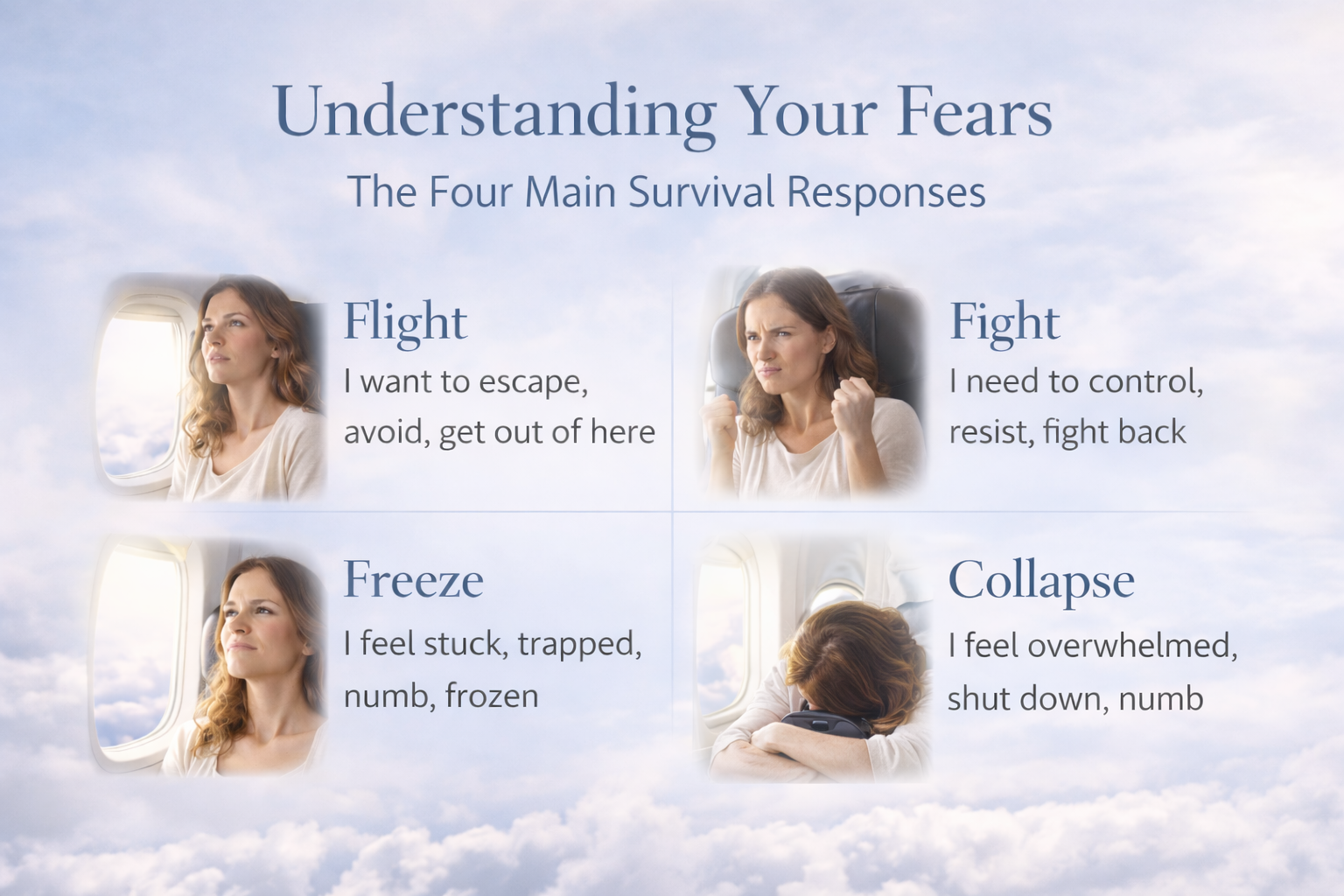
YFlight anxiety is a nervous system survival response, not a personal weakness. Flying can activate the body’s protection system so strongly that it reacts as if there is immediate danger, even when the flight is actually safe.
What Flight Anxiety Is
Our nervous system has four main survival responses: fight, flight, freeze, and collapse. Flying can trigger all of them.
Fight may show up as tension, irritation, or an urge to control everything.
Flight may feel like panic, restlessness, or the urge to escape.
Freeze can feel like numbness, mental blankness, or being stuck.
Collapse may feel like shutting down, going quiet, or feeling powerless.
These are automatic protective responses. They are not signs that you are failing.
Physical Signs
Flight anxiety can show up in the body as:
Racing heart or pounding chest.
Shallow, rapid breathing.
Butterflies or nausea in the stomach.
Tightness or contraction in the chest or belly.
Sweaty palms, shaky hands, or shaky legs.
Hot or cold flashes.
Dizziness or lightheadedness.
An urge to escape, run, or hide.
Mental and Emotional Signs
Flight anxiety can also affect thoughts and emotions:
Catastrophic thoughts like, “We’re going to crash.”
Feeling trapped or claustrophobic.
Panic about losing control.
Time distortion, where minutes feel like hours.
An urge to confess everything, ask for reassurance, or keep checking.
These reactions can feel overwhelming, but they are part of the body’s alarm system.
Why This Happens
Flying combines several common triggers at once:
Confinement: You cannot leave when you want to.
Heights: Even if you are not looking down, your body knows you are airborne.
Loss of control: The pilots are in charge, not you.
Unfamiliar sensations: Takeoff speed, engine noise, turbulence, and pressure changes can feel strange.
Sensory overload: Noise, movement, crowds, and waiting can all build stress.
Your body can interpret these as immediate danger because it is trying to protect you. That response once served an evolutionary purpose. Today, it can become overprotective.
What Helps?
The first step is to understand that your reaction is protective, not irrational. When you can name what is happening, it becomes easier to respond with breathing, grounding, reassurance, and support instead of panic.
Helpful reminders:
“My body is trying to protect me.”
“This is an alarm, not proof of danger.”
“I can feel scared and still be safe.”
“My nervous system is overreacting, not malfunctioning.”
Reflection Prompts
Which survival response do I notice most often when I fly?
What physical signs show up first for me?
Which part of flying triggers me most: confinement, heights, loss of control, or sensations?
How does it change my experience to think of this as protection rather than weakness?
Exercise: Notice, Name, Normalize
Complete these sentences:
“When I think about flying, my body usually…”
“The first sign of anxiety I notice is…”
“The trigger that affects me most is…”
“A kinder, more accurate description of my reaction is…”
This helps move the experience from confusion into understanding.
Key Card
“My nervous system is trying to protect me, even if it is overreacting.”
That understanding is the foundation for everything that follows.